14-Year-Old Develops Award-Winning JTremor-3D Device to Measure Parkinson's Tremors

By
 CSRBOX
March 25, 2025
Jui Keskar
Dealing with Parkinson’s disease requires substantial patience and effort. The continuous tremors make daily activities such as cup handling and handwriting extremely difficult. Doctor-patient medication adjustments strive to find suitable treatments even though medical records lack essential accuracy data.
Advanced tremor detection equipment is only accessible in large hospitals because it costs too much, and only these facilities maintain these systems. Multiple patients, including people living in small communities and poor neighbourhoods, lack proper medical support.
The neurological specialist care in India is deficient because outside of major urban centers there are only 500 neurologists to support more than 700,000 Parkinson’s patients. Many patients lack access to the suitable medical treatments they need.
A visionary leader introduced significant shifts to the situation. When Jui Keskar from Pune, India reached the age of fourteen, she saw her uncle struggle with Parkinson’s disease for ten chronic years. Medical professionals diagnosed his Parkinson’s disease at age 33 while repetitive shakes left him unable to perform basic activities like writing or holding beverages.
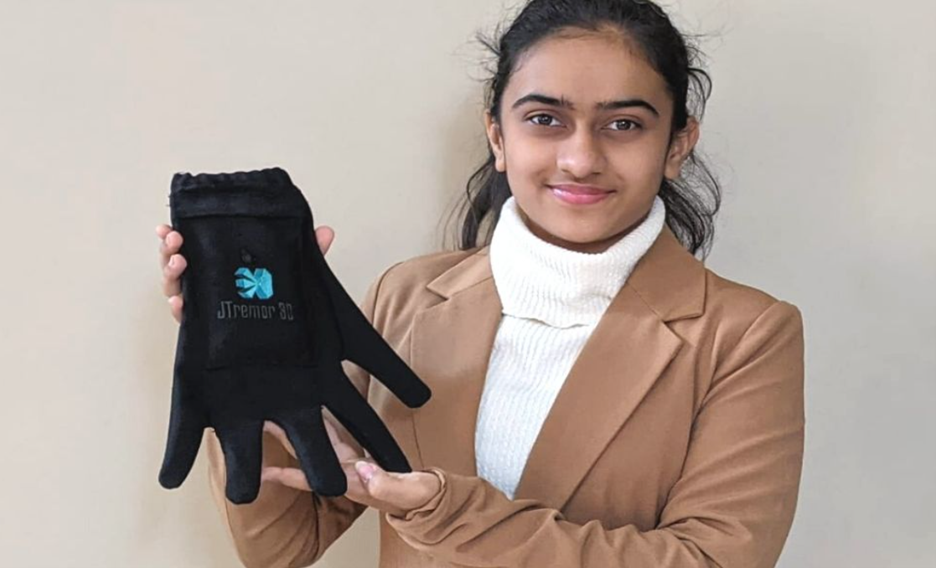
The rejection from medical professionals at CHB Hospital led Jui to develop an affordable tremor-tracking device called JTremor-3D. A product created during the lockdown period sets the foundation for individual healthcare solutions which expand global medical accessibility.
Parkinson’s affects over 10 million people globally, causing tremors, stiffness, and mobility issues. Treatment often involves trial-and-error adjustments to medication, as doctors lack tools to track tremor patterns objectively. Existing clinical devices cost thousands of dollars and are confined to hospitals, leaving home-based patients without reliable monitoring options.
Jui's uncle, who used to teach school, spent many hospital visits undergoing evaluations for his hand tremors. Every few months, his family would travel to a major city for doctors to observe his shaking hands for just a few minutes. Despite changing his medication based on those brief observations, his symptoms continued to worsen. Jui dedicated her extra time from school closures during the 2020 lockdown to seek out an improved approach. Through dedicated online research, she discovered that tremors reached their highest intensity during the morning and evening, which standard medical examinations did not identify.
The JTremor-3D is a lightweight, wearable glove embedded with MPU-6050 motion sensors and gyroscopes, components commonly used in drones and smartphones. These sensors record tremor intensity, frequency, and duration every 1/10th of a second, capturing nuances invisible to the naked eye.
Data is transmitted wirelessly via Bluetooth to a smartphone app, where custom algorithms analyze patterns and generate colour-coded reports for doctors.
Jui taught herself Python programming through free online courses to develop the app’s data-processing features. Early prototypes involved bulky Arduino boards strapped to her uncle’s hands with Velcro. “The first version weighed 300 grams and kept slipping off,” she says.
Over ten months, she experimented with 3D-printed frames and flexible circuit boards, eventually shrinking the device into a cotton glove weighing just 150 grams. The final prototype cost ₹9,000 ($110), using locally sourced materials to keep production affordable.
In January 2021, Jui’s innovation won the Broadcom-IRIS Grand Award, a national science competition where over 5,000 students competed. Judges praised her focus on affordability—a stark contrast to existing high-cost solutions.
Months later, she represented India at the Regeneron International Science Fair in the U.S., presenting her work to global experts. Her accolades include the Dr. APJ Abdul Kalam National Innovation Award and the INSPIRE-Manak Award, cementing her role as a rising star in MedTech.
Observing patients through the JTremor-3D allows doctors to develop more accurate treatment approaches. Patients using JTremor-3D at Mumbai’s Jaslok Hospital showed reduced emergency department visits by 40% according to neurologist Dr. Anil Patil.
Daytime tremor tracking enables doctors to plan proactive medication adjustments in order to stop symptoms from deteriorating. The updated version of the JTremor-3D has enabled Jui's uncle to schedule his daily activities around his tremor peaks, which helps him maintain control of his Parkinson's Disease.
The JTremor-3D has already made waves in Parkinson’s care. In a six-month pilot across 10 villages in Maharashtra, health workers screened 2,000 elderly residents, identifying 12 undiagnosed Parkinson’s cases. Patients like 70-year-old Laxmi Gaikwad, who once hid her trembling hands out of shame, now share data openly. “My doctor calls me ‘Professor’ because I track my tremors like a project,” she laughs.
Globally, organizations like Kenya’s Neuroscience Institute and Brazil’s Parkinson’s Association have requested prototypes. Jui’s Tremor Index—a 1–10 scale rating tremor severity—is being studied for use in drug trials. “This index could standardize how we measure treatment efficacy,” says Dr. Maria Lopez, a movement disorder specialist in Spain.
To scale the JTremor-3D’s impact, Jui aims to secure ISO medical certifications by 2025, a process she’s navigating with mentors from India’s National Innovation Foundation. She’s filed two patents covering the device’s sensor array and data algorithms. Partnerships with Pune-based TechMahindra could automate production, slashing costs to ₹5,000 ($60).
Nonprofits like Parkinson’s Foundation India plan to train community health workers via video tutorials in regional languages. Jui also envisions integrating the device with telemedicine apps like Practo, enabling remote consultations. “My dream is to see this glove in every primary health center,” she says.
Schools are adopting her journey into STEM curricula. At a recent workshop in Bangalore, students built mock sensors using cardboard and foil. “Jui showed us you don’t need labs to solve big problems,” says 13-year-old participant Riya Mehta.

More Stories

CSRBOX is India’s leading CSR knowledge and impact intelligence driven media platform for the development community. It serves as an enabler, encouraging collaboration and partnerships between CSR stakeholders. Here, we connect and inform over three million professionals through our online platform, and bridge information gaps by providing a range of services for Corporate, NGOs and Social enterprises, to enhance their capacities, aid collaboration, plan projects, publish knowledge resources, conduct research, amplify their reach and much more.
Submit CSR News
Please submit your CSR news, CSR impact story ideas to us. Our Team will get back to you within 6-12 working hours. You can also email us at info@csrbox.org© Renalysis Consultants Pvt Ltd. All Rights Reserved | Powered by NGOBOX