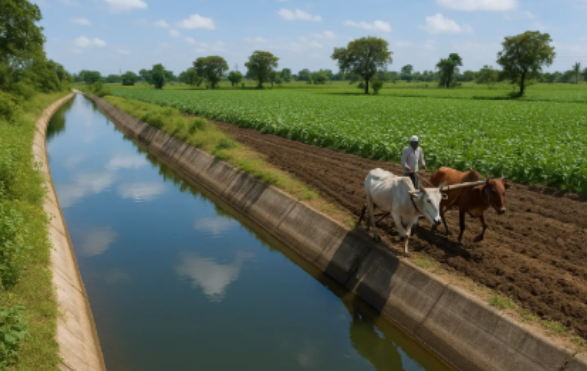
Canal of Change: How Allcargo’s CSR Initiative Revived Water and Livelihoods in Nagpur
For decades, the Vidarbha region of Maharashtra has been a symbol of both agricultural potential and human struggle. Known for its fertile soil and farming communities, this belt has also carried the heavy burden of climate uncertainty. Erratic rainfall, frequent droughts, and prolonged dry spells have left thousands of families in distress. Nagpur district, and specifically the villages around Sawangi, faced some of the worst impacts.
Once self-sufficient farmers were pushed to the brink as crops failed and water became increasingly scarce. The Sawangi Canal, once a lifeline that supported farming cycles and daily needs, had lost its vitality. Over the years, it became clogged with silt and debris, its water-holding capacity diminished, and its role as the mainstay of village life eroded.
The impact was devastating. Agricultural output declined, livestock weakened without steady water access, and families were forced into hard decisions, whether to continue farming in hardship or migrate to urban centres in search of livelihoods. The social cost was equally severe: women walking miles to fetch drinking water, children missing school to support household chores, and communities witnessing the silent erosion of dignity and stability.
In response to this escalating crisis, the Allcargo Group’s CSR arm, Avashya Foundation, launched the Sawangi Canal Restoration Project in February 2023. The initiative was not just about repairing a water channel but about restoring balance between humans and nature, scarcity and resilience, despair and hope.
Determining the Issue: When Water Becomes a Luxury
The water crisis in Sawangi and nearby villages was not a sudden phenomenon. It was the result of years of neglect, climate change, and unsustainable water practices. The Vidarbha region is notorious for its vulnerability to erratic weather patterns, which directly affect agricultural livelihoods. Without reliable irrigation systems, farmers depend heavily on monsoon rains. When those rains fail, survival itself becomes uncertain.
The impact cascaded through everyday life:
● Agriculture declined – Fertile fields that once supported diverse cropping seasons could barely sustain a single crop. Families that once thrived on multiple harvests became dependent on one uncertain yield.
● Women bore the brunt – With water sources drying up, women walked long distances to fetch drinking water, consuming hours of their day and draining their physical strength.
● Children’s education suffered – In many households, children had to miss school during dry months to assist in fetching water or supporting the family in other survival tasks.
● Livestock dwindled – Animals, critical to both farming and household sustenance, struggled without steady access to water, further reducing household income.
● Mental health deteriorated – The despair of failed harvests, mounting debts, and unending hardship drove some farmers to extreme measures, contributing to Vidarbha’s troubling record of farmer suicides.
This crisis was not isolated to Sawangi. It was part of a larger ecological and developmental imbalance in Maharashtra, deteriorating water bodies, ineffective irrigation infrastructure, soil erosion, and inadequate conservation practices, creating a cycle of loss. In Sawangi, the clogged canal stood as a stark symbol of how neglect of natural resources can multiply human suffering.
Campaign Details: Fostering Hope, One Canal at a Time
The Sawangi Canal Restoration Project was designed as a comprehensive and sustainable intervention. Unlike a short-term repair job, it was structured as a long-term community movement that blended engineering solutions with local participation and ecological awareness.
Implemented in collaboration with grassroots organizations Sadbhavana Gramin Vikas Sanstha and Purti Sinchan Samruddhi Kalyankari Sanstha, the project drew heavily on local knowledge and on-ground experience. Together, these partners ensured that the initiative was not imposed from outside but emerged as a shared vision between the community and the foundation.
The restoration plan included several key measures:
● Canal widening and deepening: A 4.11 km stretch of the canal was widened and deepened, from ridge to valley, increasing its ability to store and channel water effectively.
● Water storage capacity: The project created 1,00,000 cubic metres of surface water storage, ensuring adequate availability during dry months.
● Soil conservation: The canal bed was desilted and strengthened to prevent erosion, helping maintain soil health and fertility in surrounding fields.
● Groundwater recharge: With careful planning, the project enabled 2,25,000 cubic metres of annual groundwater recharge, creating a buffer against future scarcity.
The project adopted the Tamaswada pattern of water conservation, a proven approach in the region that emphasizes ecological balance and sustainability.
Equally significant was the community engagement model. Farmers, especially from marginalized groups, were included in every stage, from planning to implementation and tracking progress. This participatory framework ensured two outcomes: transparency in execution and a strong sense of ownership among local people.
When farmers and families become co-owners of such projects, the long-term sustainability of results is almost guaranteed.
Public Recognition and Community Transformation
The restoration project soon began showing visible results. The canal, once choked with silt, started flowing freely again. Water reached fields that had been parched for years, livestock could drink without difficulty, and women found relief from the exhausting task of fetching water from distant sources.
The project also gained recognition beyond the villages. Its success highlighted how corporate social responsibility, when aligned with genuine social need, could create a sustainable impact. By linking resources with community-driven execution, the Sawangi project set an example of how local ecological crises can be addressed in meaningful ways.
For the community, the change was more than physical. It was psychological and emotional too. Where there had once been despair, hope began to return. Families started planning for second crops, children were back in schools, and households could once again imagine a stable future in their ancestral villages.
Impact Created
The Sawangi Canal Restoration Project has brought transformative and measurable outcomes for the region. More than 3,000 individuals have indirectly benefited through improved water accessibility and revitalized farming systems, while 1,200 farmers now enjoy enhanced irrigation facilities that have reduced their dependence on erratic monsoon rains.
Around 200 families today have reliable access to safe drinking water, leading to better health and hygiene standards. The project has also restored fertility across 400 hectares of farmland, allowing farmers to shift from single cropping to more diverse agricultural practices, thus improving food security and income stability.
Beyond agriculture, the restoration has had a far-reaching impact on the environment and rural economy. Groundwater recharge has reduced reliance on borewells and stabilized water availability, while improved access to water has enhanced livestock productivity, strengthening dairy yields and contributing to household incomes.
Early signs of ecological revival are also visible, with the return of small wildlife serving as a powerful reminder of nature’s resilience. Collectively, these outcomes show that water conservation is not only about survival, it is about unlocking opportunities, restoring livelihoods, and enabling communities to dream of a sustainable future.
Way Forward
The success of the Sawangi Canal Restoration Project has laid the foundation for larger ambitions. For the Allcargo Group and Avashya Foundation, the journey does not end with one canal.
The long-term vision is to replicate this model in other drought-prone districts of Maharashtra, ensuring that water security becomes a shared reality rather than a distant aspiration.
Future goals include:
● Decentralized conservation: Scaling localized water management practices that are tailored to the needs of specific geographies.
● Public-private partnerships: Leveraging collaboration between corporations, local bodies, and NGOs to maximize impact.
● Capacity building: Training communities and strengthening governance structures to ensure projects remain sustainable in the long run.
● Policy advocacy: Encouraging frameworks that integrate grassroots voices into water management decisions at the district and state levels.
The Sawangi Canal Project has shown that when communities, corporations, and civil society come together, the results can be both powerful and lasting. Water, once a symbol of hardship in Sawangi, has become a stream of resilience and prosperity, restoring not just land and crops, but the dignity and dreams of an entire region.

CSRBOX
CSRBOX.org is the single largest CSR information dashboard for CSR heads, board members of companies, nonprofit leaders, fundraisers, government agencies and social businesses to find latest updates in CSR domain in India. The platform is powered by India's largest social sector platform NGOBOX.
IMPACT TALKS

|

|

|

|

|

|


