How Titan’s CSR Program Is Transforming Hosur’s Water Ecosystem Through Lake Rejuvenation
Hosur’s rapid transformation into a major industrial and residential hub has brought economic growth but has also placed sustained pressure on its natural water systems. Urban expansion, reduced percolation areas, siltation of lakes, and the inflow of untreated sewage have collectively weakened the region’s traditional waterbodies.
SIPCOT Hosur Lake, once a vital component of the town’s water infrastructure, was increasingly losing its ability to manage stormwater, recharge groundwater, and support biodiversity. Its declining capacity posed risks not only to ecological balance but also to water security and quality of life for surrounding communities.
Responding to these challenges, Titan Company Limited stepped in with a structured, collaborative lake rejuvenation initiative under its Sustainability (Pragati) programme, positioning environmental restoration as a long-term solution to Hosur’s growing urban water stress.
Restoring a Critical Waterbody in Hosur’s Hydrological Network
SIPCOT Hosur Lake occupies a strategically important position in the region’s hydrological system. Spanning 10.5 acres and supported by a catchment area of 78.71 hectares, the lake is hydrologically connected downstream to Santhapuram Lake and eventually to the Ponniyar River.
This linkage makes it a crucial intermediary in regulating surface runoff, moderating floods during monsoon periods, and sustaining downstream water flows.
Hosur receives an average annual rainfall of 750–800 mm, much of which arrives in short, intense spells. In such a climate, well-functioning lakes act as buffers against flooding while enabling slow percolation that replenishes aquifers.
However, years of neglect had reduced SIPCOT Hosur Lake’s effective storage capacity, limiting its ability to perform these essential functions. Sedimentation had shallowed the lake, while blocked inlets and surrounding development disrupted natural inflows.
Restoring this lake was therefore not merely an aesthetic exercise but a necessity for strengthening Hosur’s overall water resilience amid increasing industrial and domestic demand.
Collaborative Execution Under the Pragati Initiative
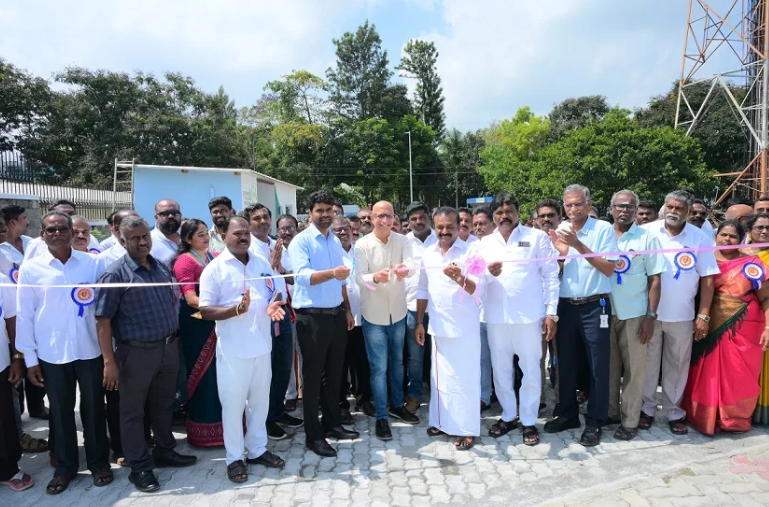
The rejuvenation of SIPCOT Hosur Lake was undertaken by Titan Company Limited as part of its Sustainability (Pragati) commitments, reinforcing the company’s focus on water stewardship and community-centric development.
The project was implemented under the Tamil Nadu government’s Namakku Naame Thittam scheme, ensuring alignment with public infrastructure priorities and local governance frameworks.
The initiative was executed in collaboration with Hosur Municipal Corporation and SIPCOT, reflecting a shared responsibility between industry and government in managing urban commons. Technical execution was carried out by Surya Shakti Greenlands Pvt. Ltd. and Infrastructure Development Corporation (Karnataka) Limited (iDeCK), bringing together environmental planning, engineering expertise, and on-ground implementation capabilities.
This collaborative model allowed the project to address multiple dimensions simultaneously: hydrological efficiency, ecological restoration, and public usability, while ensuring regulatory compliance and long-term maintenance considerations.
As Titan’s third major water-related intervention in Tamil Nadu within the year, the SIPCOT Hosur Lake project also demonstrated a scalable approach to urban waterbody rejuvenation that can be replicated across similar industrial towns.
Infrastructure, Ecology, and Community-Centric Enhancements
At the core of the project was a significant upgrade to the lake’s physical infrastructure. The water-holding capacity was increased threefold, from 5.6 crore litres to 17.1 crore litres, dramatically enhancing the lake’s ability to capture and store rainwater.
Deepening the lake from an average of 1.5 metres to 8 metres reduced evaporation losses, improved water retention across seasons, and strengthened groundwater recharge potential.
Structural measures such as bund strengthening and stone pitching were undertaken to stabilise the lake’s embankments, protect against erosion, and improve resilience during heavy rainfall events. These interventions ensure that the lake can function reliably as a stormwater management asset in the long term.
Ecological restoration formed another critical pillar of the rejuvenation effort. A 40,000 square foot Miyawaki forest island was created within the lake precinct to promote rapid, dense growth of native vegetation.
This approach enhances biodiversity, supports bird and insect populations, and improves microclimatic conditions. In addition, more than 4,300 saplings were planted around the lake to develop a robust greenbelt, strengthening ecological connectivity and improving air quality.
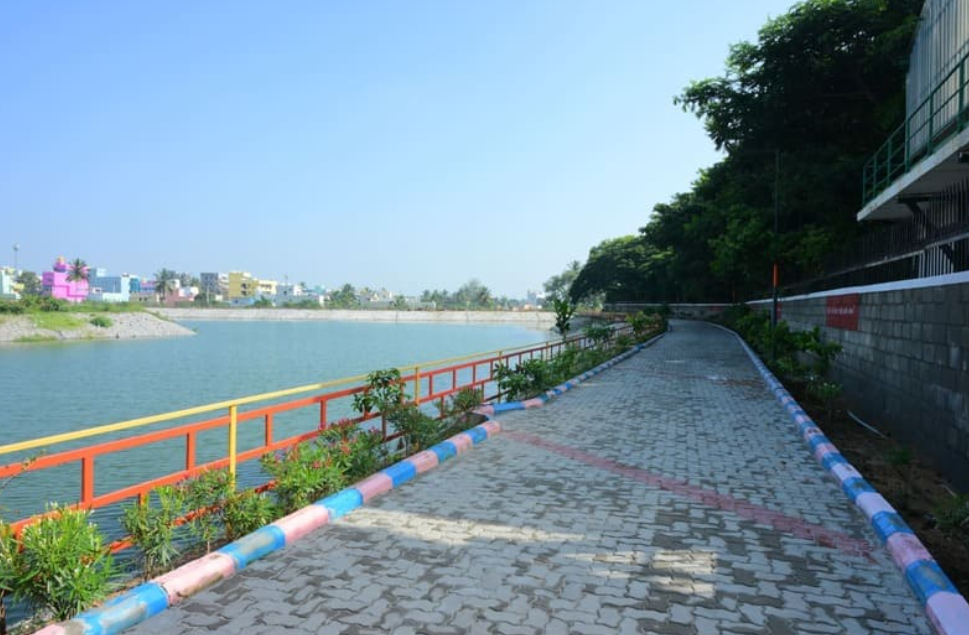
Equally important was the integration of the lake into the social fabric of the city. A 950-metre walking and jogging track was developed along the lake’s periphery, encouraging physical activity and daily engagement by residents.
Safety and accessibility were prioritised through the installation of fencing, lighting, and designated social spaces, transforming the lake from a neglected waterbody into a welcoming public asset. Inlet clearing and sewage diversion were also carried out to prevent contamination, significantly improving water quality and ensuring that ecological gains are sustained over time.
Impact Created
The rejuvenation of SIPCOT Hosur Lake has delivered a measurable and multidimensional impact for Hosur and its surrounding communities.
From a water management perspective, the tripling of storage capacity has strengthened local water security and enhanced the town’s ability to manage monsoon runoff, reducing flood risk in downstream areas. Improved depth and desilting have boosted groundwater recharge, supporting borewells and mitigating seasonal water scarcity.
Ecologically, the introduction of native vegetation, the Miyawaki forest island, and expanded green cover have revitalised local biodiversity. The lake now functions as a habitat for birds and aquatic life while contributing to improved microclimate regulation and reduced urban heat stress.
Socially, the transformed lake has emerged as a green lung and recreational space for Hosur’s residents. The walking track and public amenities encourage regular community interaction, promote healthier lifestyles, and foster a sense of shared ownership over the restored ecosystem. Enhanced safety features have increased accessibility for people of all ages.
At an institutional level, the project stands as a strong example of effective public–private partnership. By aligning corporate CSR objectives with municipal priorities, the initiative demonstrates how collaborative governance can unlock sustainable solutions for complex urban environmental challenges.
Way Forward
The successful rejuvenation of SIPCOT Hosur Lake reinforces the importance of integrated, long-term approaches to urban water management. Building on this momentum, Titan Company’s Sustainability (Pragati) initiative continues to focus on restoring interconnected water systems rather than isolated assets.
Future efforts are expected to emphasise catchment-level planning, continuous monitoring, and community engagement to ensure that restored lakes remain healthy and functional over time.
As climate variability, urbanisation, and water demand continue to intensify, such holistic interventions offer a pathway to resilient cities. By combining ecological restoration, robust infrastructure, and inclusive public spaces, the SIPCOT Hosur Lake project sets a precedent for how industry-led CSR initiatives can contribute meaningfully to environmental sustainability, community well-being, and long-term urban resilience across Tamil Nadu.

CSRBOX
CSRBOX.org is the single largest CSR information dashboard for CSR heads, board members of companies, nonprofit leaders, fundraisers, government agencies and social businesses to find latest updates in CSR domain in India. The platform is powered by India's largest social sector platform NGOBOX.
IMPACT TALKS

|

|

|

|

|

|


