How Toyota Kirloskar Motor’s CSR Program ‘iCARE’ Is Supporting Women-Led Self-Help Groups
Across rural India, women-led Self-Help Groups (SHGs) have emerged as powerful engines of socio-economic change. They enable women to pool resources, access credit, and collectively build livelihoods that support their families and communities.
Despite their potential, many SHGs face persistent challenges that limit their growth. These include inadequate access to production tools, limited exposure to sustainable business practices, lack of technical guidance, and difficulty in scaling operations beyond local markets.
As a result, several women-led micro-enterprises remain confined to small, informal operations, unable to realise their full economic potential.
Recognising these structural barriers, Toyota Kirloskar Motor (TKM) introduced targeted interventions under its Employee Volunteerism Program, iCARE (Community Action to Reach Everyone).
Through its 34th iCARE initiative, TKM addressed these challenges by combining employee participation, skill transfer, and sustainability-driven support to strengthen women-led SHGs engaged in eco-friendly micro-enterprises.
The initiative focused on enabling rural women entrepreneurs to build resilient, scalable, and environmentally conscious livelihoods.
Empowering Rural Women Through Collective Action
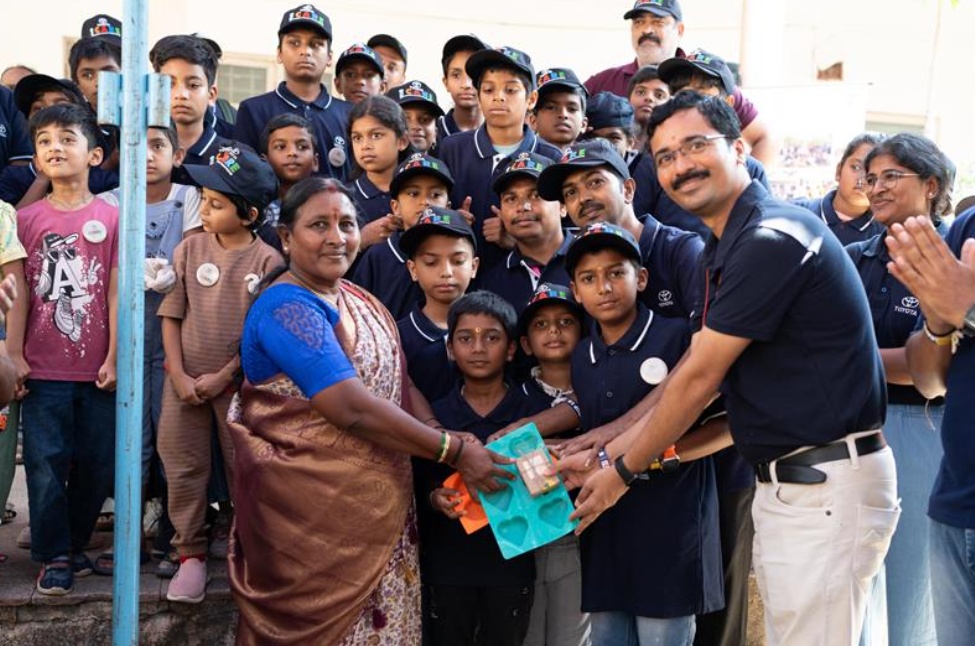
The 34th iCARE initiative was held at NSS Bhavan, Bangalore University, and brought together community members and corporate volunteers with a shared purpose of women’s economic empowerment.
More than 250 iCARE volunteers, comprising TKM employees and their family members, actively participated in the initiative. Their involvement went beyond symbolic volunteering, reflecting a hands-on approach to community development.
The core activity centred on supporting women-led SHGs involved in the production of natural soaps and soap powders. Volunteers and SHG members worked together to produce 1,000 eco-friendly natural soaps during the initiative.
This collaborative production effort directly strengthened the SHGs’ inventory, enabling them to meet existing demand and prepare for future sales. For the women entrepreneurs, this immediate output translated into greater confidence, improved market readiness, and tangible progress toward business expansion.
Collective action played a critical role in this process. By working alongside SHG members, volunteers helped reinforce the value of teamwork, shared responsibility, and mutual learning. This approach fostered trust and encouraged open exchange of ideas, creating a supportive environment in which rural women could actively engage, learn, and lead.
Enabling Sustainable Micro-Enterprises
One of the most significant barriers faced by rural SHGs is the lack of access to appropriate infrastructure and production tools. Without these, maintaining quality, consistency, and efficiency becomes difficult, restricting the ability to scale operations. The iCARE initiative addressed this gap by enabling access to essential resources required for sustainable production.
TKM facilitated the provision of environmentally friendly moulds, soap-making tools, vessels, and sustainable packaging materials to the participating SHGs. These resources were carefully chosen to support eco-conscious production while improving operational efficiency.
The availability of proper tools not only enhanced productivity but also reduced dependency on manual or improvised processes that often lead to inconsistencies in output.
Sustainability was embedded as a core principle of the initiative. By encouraging the use of natural ingredients and eco-friendly packaging, the program helped SHGs align their businesses with growing consumer demand for environmentally responsible products. This positioning strengthens the long-term viability of the enterprises while contributing to broader environmental goals.
The focus on sustainable micro-enterprises also supported the creation of value beyond income generation. It enabled rural women to become contributors to local green economies, reinforcing the idea that livelihood development and environmental responsibility can progress together.
Building Skills for Long-Term Growth
While access to tools and materials is essential, long-term success for SHGs depends heavily on skills, knowledge, and efficient processes. Recognising this, the iCARE initiative placed strong emphasis on capacity building and skill transfer.
TKM employees actively supported SHG members by sharing technical know-how and productivity-focused practices. Drawing from principles of continuous improvement and operational efficiency, volunteers provided hands-on guidance to optimise production workflows.
This included improving batching processes, maintaining quality consistency, reducing material wastage, and managing time more effectively during production cycles.
These interventions helped SHGs enhance their day-to-day productivity while developing a deeper understanding of structured processes. Over time, such improvements create a strong operational foundation, enabling women entrepreneurs to scale their businesses sustainably rather than relying on short-term output gains.
Importantly, this knowledge transfer empowered SHG members to take ownership of their enterprises with greater confidence. By understanding how to streamline operations and improve quality, rural women were better equipped to explore new markets, expand to neighbouring villages, and engage with customers more professionally.
Strengthening Community-Based Women Enterprises
The initiative specifically supported women-led SHGs such as Sreelakshmi Swasahaya Sanga and Basaveshwara Swami Mahila Swasahaya Sanga in the rural villages of Ramanagara district, Karnataka. These groups have been actively engaged in producing natural soaps and soap powders as a source of livelihood.
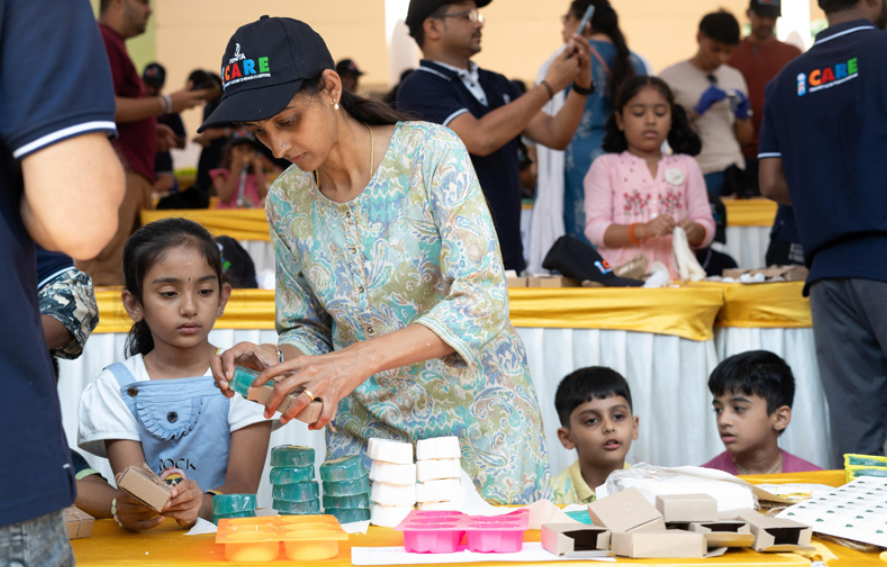
Through the iCARE intervention, these SHGs received not only production support but also strategic inputs aimed at strengthening their business outlook. Improved inventory levels, better tools, and enhanced operational practices collectively enabled these groups to move closer to their goal of expanding operations into neighbouring villages.
By strengthening women-led enterprises at the community level, the initiative contributed to broader social outcomes. Increased income stability for women often translates into improved household well-being, better access to education and healthcare, and stronger community resilience.
In this way, the impact of the initiative extended beyond individual entrepreneurs to benefit families and local ecosystems.
Impact Created
The initiative created a meaningful and lasting impact for women-led Self-Help Groups in the Ramanagara district of Karnataka by strengthening their production capacity and improving overall operational efficiency.
Through collaborative efforts, the SHGs were able to produce 1,000 eco-friendly natural soaps, significantly boosting their inventory levels and enhancing their readiness to meet market demand.
Access to sustainable tools, moulds, equipment, and eco-conscious packaging materials further supported the continuity and scalability of their micro-enterprises, reducing operational constraints and dependency on improvised resources.
The hands-on guidance provided during the initiative enhanced technical skills, streamlined production processes, and improved productivity, laying a strong foundation for long-term growth.
By integrating environmentally responsible practices into livelihood generation, the initiative aligned rural enterprises with rising eco-conscious consumer trends. Collectively, these interventions strengthened women’s financial independence, built entrepreneurial confidence, and contributed to more inclusive and resilient rural development.
Way Forward
Toyota Kirloskar Motor’s iCARE initiative reflects a long-term commitment to inclusive and sustainable development. By aligning its CSR efforts with national priorities such as Viksit Bharat 2047, Skill India, and women’s empowerment through rural entrepreneurship, TKM continues to complement broader development goals.
Going forward, sustained engagement with women-led SHGs will remain critical. Continued capacity building, access to improved market linkages, and deeper integration of sustainability practices can further strengthen these enterprises. Partnerships with local government bodies, institutions, and community organisations will play an important role in scaling impact and ensuring continuity.
Through its six core CSR pillars, Education, Health & Hygiene, Environment, Skill Development, Road Safety, and Disaster Management, TKM aims to create holistic, community-driven change. By investing in rural women entrepreneurs today, the iCARE initiative is helping build self-reliant communities, resilient local economies, and a more inclusive path to long-term development.

CSRBOX
CSRBOX.org is the single largest CSR information dashboard for CSR heads, board members of companies, nonprofit leaders, fundraisers, government agencies and social businesses to find latest updates in CSR domain in India. The platform is powered by India's largest social sector platform NGOBOX.
IMPACT TALKS

|

|

|

|

|

|


