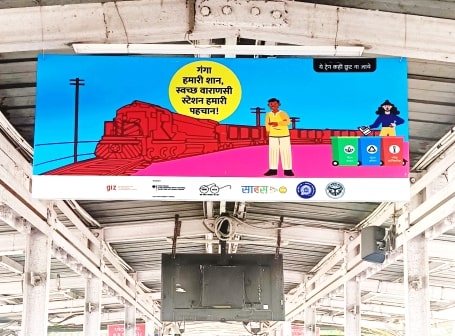
Journey of going “zero-waste”: case study of Varanasi Cantt. railway station
Solid waste management (SWM) has long been a pressing issue across the country. The unsightly accumulation of garbage and its harmful impact on the environment through landfill pollution are increasingly evident, along with its ramifications on environment and health.
Solid Waste Management Rules, 2016 provides policy guidelines for scientific disposal of waste. It also categorizes entities generating >100 kg waste per day as Bulk Waste Generators (BWGs), who are directed to manage their organic waste ‘in-situ’, thereby promoting decentralized solutions. This reduces the load on municipalities while also promoting accountability amongst waste generators.
By virtue of definition, most of the high traffic institutions such as railway stations, fall under the purview of BWGs. However, currently, they lack the capacity to create sustainable systems. Thus, Saahas, a leading NGO in waste management for the past two decades undertook a pilot initiative to transform the Varanasi Cantt. railway station, in the Lucknow Charbagh division of eastern Uttar Pradesh, into a model zero-waste entity. This project was undertaken as part of the GIZ project on “Circular Economy Solutions (CES) Preventing Marine Litter in Ecosystems'' with support from MoEFCC.
Generating a substantial 2.5 to 3 MT of waste daily, the railway station did not have a system of waste segregation. All the waste collected from platform bins, vendors, waiting rooms etc was mixed, hence was transported to a dump yard in the station premise, leading to negligible resource recovery.
Saahas adopted a 7-step intervention comprising the following actions aimed at enhancing sustainability and improving waste management within the station's premises:
The zero waste management activities included waste segregation at the platforms by the platform vendors, and proper transfer of the segregated waste to the MRF/composting facility. This was done in coordination with Northern Railways, MoEFCC and the State government of Uttar Pradesh (U.P.). This pilot project for establishing Varanasi Cantt Railway station as a model zero-waste BWG has set a precedent for more such initiatives across the country.
IMPACT TALKS

|

|

|

|

|

|
IMPACT STORIES
|
|
|
|
|
|


